
How Travel Nurse Pay Actually Works in 2026: Base Rate, Stipends, and What Nobody Explains Clearly

How Travel Nurse Pay Actually Works in 2026: Base Rate, Stipends, and What Nobody Explains Clearly
If you have ever looked at a travel nurse pay package and thought — wait, what is actually in here and why does this look so different from what my friend is getting — you are not alone.

Travel nurse pay is genuinely confusing. Not because it needs to be, but because the industry has never standardized how it is presented. One agency shows you a blended hourly rate. Another shows you a base rate plus stipends. A third sends you a weekly take-home number with no explanation of what is behind it. All three could be paying you the same total amount — or very different amounts — and you would have no easy way to know.

This article explains the full structure of travel nurse pay in plain language. By the end you will know what every number in your package means, what questions to ask your recruiter, and how to compare offers across agencies without getting lost in the math.

This guide covers the pay structure for US-based travel nursing assignments. Tax rules vary by individual situation — always consult a travel nurse-savvy CPA or tax advisor before making decisions based on stipend eligibility.

The basic structure: two buckets, very different rules

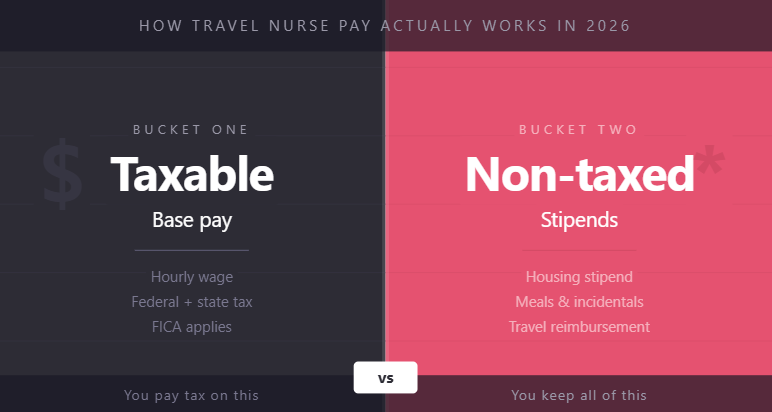
Every travel nurse pay package is made up of two fundamentally different types of compensation. Understanding the difference between them is the most important thing in this entire guide.

Bucket one is your taxable base pay. This is your hourly wage — the portion of your earnings that the IRS treats as regular income and taxes accordingly. It is subject to federal income tax, state income tax where applicable, Social Security, and Medicare. This number is usually lower than what a staff nurse earns per hour, which surprises many people seeing a travel package for the first time.

Bucket two is your non-taxable stipends. These are reimbursements — not wages — provided to cover the additional costs of working away from home. Because they are reimbursements rather than income, the IRS does not tax them. They include a housing stipend to cover the cost of temporary accommodation near your assignment, a meals and incidentals stipend (sometimes called M&IE) for daily living expenses, and in some packages a travel reimbursement for the cost of getting to and from your assignment location.
When you add both buckets together — taxable base pay plus non-taxable stipends — you get your total weekly compensation. This is the number that matters most when comparing packages.

Example: A package offering $22/hour taxable base pay plus $1,200/week in non-taxable stipends might look less attractive than a $35/hour all-taxable offer — until you do the math. At 36 hours per week, the first package totals $2,992 gross before taxes. The second totals $1,260 gross before taxes. The stipend structure makes an enormous difference to take-home pay.

The tax home: why it is the most important concept in travel nursing

Here is the thing that many travel nurses learn the hard way: you can only legally receive non-taxed stipends if you have a tax home.
A tax home, in IRS language, is your principal place of business or work — the geographic area where you earn the majority of your income or where your permanent residence is located. For a travel nurse, it is typically the location of your permanent home. To maintain a tax home, you generally need to be paying regular living expenses at that location — rent, a mortgage, utilities — even while you are away on assignment.
Why does this matter? Because if you do not have a tax home — if you gave up your apartment, sold your house, and have no fixed address you return to — the IRS considers you an itinerant worker. Itinerant workers are not traveling away from home; they simply work wherever they happen to be. In that situation, your agency is legally required to make all of your compensation taxable. The stipends disappear from your package because the IRS says they are not reimbursements for duplicated living expenses — they are just income.
This is one of the most misunderstood areas of travel nursing and one of the most consequential. Nurses who give up their permanent residence to travel full-time and expect to receive tax-free stipends are in a legally and financially precarious position. Before you make any decision about your permanent residence, speak with a CPA who specializes in travel nurse taxation.

The IRS also requires that you be working a substantial distance from your tax home — generally 50+ miles — to qualify for non-taxed travel reimbursements. Assignments close to your permanent home may not qualify for all components of the stipend package.

How to compare packages across agencies (without getting tricked)

One of the most frustrating things about traveling with multiple agencies or comparing offers is that every agency structures their packages differently. Some show a blended rate — a single hourly number that combines your taxable base pay and stipends into one figure for ease of comparison. Others show the full breakdown. Neither format is dishonest on its own, but they make direct comparison almost impossible without doing the math yourself.

Here is the only framework you need. To compare any two packages on equal terms, calculate the total weekly gross compensation for a standard 36-hour week:

  • Take the taxable hourly rate and multiply by 36 hours.
  • Add the weekly housing stipend.
  • Add the weekly meals and incidentals stipend.
  • Add any weekly travel reimbursement.
  • That is your total weekly gross. Compare this number across packages.
Do not compare hourly rates in isolation. A $28/hour rate with a $1,400/week stipend may be worth significantly more than a $38/hour blended rate with no stipend breakdown. The only number that matters is total weekly gross, and the only way to get it is to ask for the full breakdown.

How to compare packages across agencies (without getting tricked)

  • What is the taxable hourly base rate?
  • What is the weekly housing stipend?
  • What is the weekly meals and incidentals stipend?
  • Is there a travel reimbursement? How is it paid — upfront, per diem, or at completion?
  • What is the total weekly gross for a standard 36-hour week?
  • Are there overtime rates? At what threshold and at what rate?
  • Is there a completion bonus? What are the conditions to receive it?
  • What happens to the package if the facility cancels my shift?

Benefits: the part of the package that deserves more attention

Pay is not the only thing in a travel nursing package. Benefits can add or remove thousands of dollars of value per assignment, and they are often the least carefully compared component.

Health insurance

Most agencies offer health insurance, but the details vary significantly. Key questions: when does coverage start — day one of your assignment or after a waiting period? What is your weekly premium contribution? What is the plan’s deductible and out-of-pocket maximum? Is dental and vision included? For nurses who travel frequently and take short gaps between assignments, understanding what happens to coverage during those gaps matters enormously.

401(k)

Some agencies offer a 401(k) with employer matching. Others offer one with no match. Some have eligibility waiting periods of 90 days or more, which means short-term travelers may never actually vest. If retirement savings are important to you, ask specifically: is there a 401(k), is there an employer match, what is the vesting schedule, and what is the eligibility waiting period?

Professional liability and workers' compensation

Most reputable agencies carry professional liability coverage for their nurses while on assignment. Confirm this before you sign. Workers’ compensation should also be confirmed — you are an employee of the agency, not the facility, and your coverage comes through the agency.

Completion bonuses, overtime, and the fine print

Some packages include a completion bonus — a lump sum paid at the end of the assignment for completing the full contract. These can range from a few hundred dollars to several thousand and can be a meaningful part of total compensation. The key questions: what are the exact conditions required to receive the bonus, what constitutes a contract violation that forfeits it, and is it taxable?
Overtime is another area where packages vary. Federal law requires overtime pay at 1.5x after 40 hours per week. Some facilities run 12-hour shifts and regularly schedule travel nurses for overtime. Confirm the overtime rate in your package and understand exactly at what threshold it kicks in — some agencies calculate it differently than you might expect.
The cancellation policy is the fine print most nurses do not read carefully enough until it affects them. If a facility cancels your shift, are you guaranteed a minimum number of hours per week? If so, how many and under what conditions? Low-census cancellations are common in healthcare — understanding your guaranteed hours in writing before you sign a contract protects you when census drops unexpectedly.

What to look for in a transparent agency

The most reliable indicator of a trustworthy travel nursing agency is transparency about pay structure. A recruiter who can give you a complete, itemized breakdown of any package — taxable base, each stipend component, benefits summary, overtime rate, completion bonus conditions — without being asked multiple times is a recruiter you can work with confidently.
A recruiter who gives you a blended rate and deflects when you ask for the breakdown, or who cannot tell you the taxable base rate, or who presents housing stipend amounts that seem implausibly high relative to the base pay — those are signals to probe further. Non-taxable stipends have IRS-established limits. Packages that show very low taxable base pay and very high stipends may cross compliance lines that create tax problems for the nurse down the road, not the agency.
At Cynet Health, every recruiter is trained to walk you through the full breakdown of any package before you sign anything. If you have questions about a current offer — whether it is with us or with another agency — our team is happy to help you understand what you are looking at.

Ready to see what your pay package could look like? Browse open travel nursing assignments at cynethealth.com or speak with a Cynet Health recruiter to get a transparent, itemized offer for roles in your specialty and preferred states.

The quick reference summary

  • Travel nurse pay = taxable base rate + non-taxable stipends (housing, M&IE, travel)
  • Non-taxable stipends require a legitimate tax home — a permanent residence you maintain expenses for
  • Always compare total weekly gross, not hourly rates in isolation
  • Ask for a full itemized breakdown of every package before you sign
  • Evaluate benefits as part of total compensation — health insurance, 401k, and liability coverage all have real dollar value
  • Completion bonuses, overtime rates, and cancellation policies belong in your contract review
  • If stipend amounts seem unusually high relative to base pay, ask questions — IRS compliance issues follow the nurse, not the agency


Get a Quick Callback from
Our Healthcare Experts

Looking for your next healthcare opportunity or staffing solution?
Speak with our team and get personalized guidance—fast.

Thank You!

Your response has been recorded. We will get back to you soon!
By submitting, you agree to receive calls and text messages from Cynet Health. Message frequency may vary, and you can opt out at any time

Have Questions? Let’s Connect

Send us a quick message and our team will get back to you shortly.

Thank You!

Your response has been recorded. We will get back to you soon!
By submitting, you agree to receive text messages from Cynet Health. Message frequency may vary, and you can opt out at any time

Personal Information

Thank You!

Your response has been recorded. We will get back to you soon!

Refer a Locum Program

Know someone looking for a locum assignment? Explore our Refer a friend program.

$2000 BONUS
If you know another talented physician or advanced practice professional who might be interested in the flexibility and rewards a locums career can provide, refer them to our company and let us reward you with $2000 for each referral.
To qualify for the bonus:
  • Refer a physician or advanced practice professional who Cynet Health has not presented to a facility or reached out to in the last 12 months.
  • Be sure to use the online referral form yourself before the candidate has been presented by Cynet Health to a healthcare facility.
  • Once the medical professional has worked the minimum qualifying hours within 12 months from the date you’ve referred them (250 hours for a physician or 500 hours for an advanced practice professional), you will be eligible to earn $2000.*
  • After 30 days of completion of the qualifying hours, your referral reward of $2000 will be processed.

Thank You!

Your response has been recorded. We will get back to you soon!

Tips for First Time Travelers

Ask yourself why you want to travel

Why do you want to travel? Is it money, the experience, or perhaps both? Can I afford to travel? How does this affect my personal life?

Know before you go

Confirm if weekends, evenings or on-call are expected. Get clarification on accommodations and other necessities.

Arrive a few days early before your report date

Be familiar with the area you will be living, as well as the lay of the facility where you will be working, and importantly, the parking if applicable. It is ideal to live withing a reasonable proximity to your new work place.

Educate yourself

There are many social media groups, travel nursing sites and experienced travelers to get insight. Join relevant support groups. It can also be a great way to make new friend.

Be flexible

Working in the medical field is no doubt demanding. Long hours and night shifts are often the norm. It is more likely that more opportunity will be available for those that can be flexible.

What to bring

As a traveler, “less is more”. The beauty of minimalism is that it allows flexibility for future opportunities. Always remember the necessities; your certifications/credentials, and government id’s. A passport and comfy shoes are recommended, too? You are a traveler, after all!

Refer a Friend Program

Know someone looking for a job in healthcare?
Explore our Refer a friend program.

$1500 BONUS
RNs – UP TO $1500 ($500 for each 13 week assignment)
LVNs/LPNs – UP TO $1000 ($333 for each 13 week assignment)
CNAs – UP TO $300 ($100 for each 13 week assignment)
$1000 BONUS

ALLIED HEALTH 1 – UP TO $1000

($333 for each 13 week assignment)
Audiologist, Cardiovascular Rad Tech, Certified Respiratory Therapist, CT Technologist, Cath Lab Technologist, CVOR Tech, Certified Occupational Therapist Assistant, Cytotechnologist, Registered Dental Hygienist, Echo Technologist, Histotechnologist, Interventional Rad Tech, Mammographer, MRI Technologist, Medical technologist, Nuclear Medicine Technologist, Occupational Therapist, registered dietician, Pharmacist, Polysomnographer, Physical Therapist, Physical Therapy Assistant, Radiology Technician, Radiation Therapist, Registered Respiratory Therapist, Social Worker, Speech Therapist, Ultrasound Technician, Vascular Technologist

$600 BONUS

ALLIED HEALTH 2 – UP TO $600

($200 for each 13 week assignment) Certified Surgical Technician, Sterile Processing Technician

ALLIED HEALTH 3 AND NON CLINICAL – UP TO $300

($100 for each 13 week assignment)
Anesthesia Technician, Dental Assistant, Dialysis Technician,
EEG Technician, Emergency Medical Technician, Medical Lab Technician, Pharmacy technician, Project Coordinator, Sleep Lab Technician, Xray Technician, Admin Asst/Secretary, Cook, Customer Service Representative, Dietary Aide, EKG Technician, Environmental Services, Medical Coder, Medical Collector, Medical Receptionist,
Any Other Position.

*Assignments have to be back to back without any gaps & referral amount is paid after completion of each assignment.

Direct Hire

$2000 BONUS
C-Level & Executives
$1000 BONUS
RNs/APPs
$500 BONUS
Allied Health
$250 BONUS
Non-Clinical

*Payable upon successful completion of the first assignment.
*For assignments less than 13 weeks, the referral bonus will be prorated.
*Referrals are valid if the candidate is not in our database or if they have had no activity for the last 12 months
*Assignments must be at least 13 weeks long to qualify for the referral bonus, and they must start within 30 days of the previous assignment (including extensions)
*The referral amount is paid after the completion of each assignment

Skip to content